
Authorised Indian Distributor
Saxsons Group
New Delhi, India · Since 1997
myOSL™ ChipBeryllium Oxide OSL Dosimeter
A reusable beryllium-oxide optically stimulated luminescent dosimeter for clinical radiotherapy. The myOSL Chip pairs a 4.7 × 4.7 × 0.5 mm BeO element with an ABS light-tight housing — a small, MR-safe, reusable detector that fits the same workflows as the discontinued Landauer nanoDot. Validated in two 2025 peer-reviewed studies for in-vivo dosimetry, TBI, TSET, electrons and out-of-field measurements.
Key Features
- Beryllium oxide (BeO) OSL element — Z_eff 7.21, density 2.85 g/cm³
- Compact light-tight ABS housing (9.5 × 10 × 2 mm) — fits in-vivo placements where nanoDot fit
- Reusable — multiple read / erase cycles with characterised sensitivity drift
- MR-safe — no metallic components, compatible with MR-guided treatment workflows
- Linearity within −0.5% to +3% over the clinically relevant 0.1–20 Gy range (Kowalski 2025)
All Features
- Beryllium oxide (BeO) OSL element — Z_eff 7.21, density 2.85 g/cm³
- Compact light-tight ABS housing (9.5 × 10 × 2 mm) — fits in-vivo placements where nanoDot fit
- Reusable — multiple read / erase cycles with characterised sensitivity drift
- MR-safe — no metallic components, compatible with MR-guided treatment workflows
- Linearity within −0.5% to +3% over the clinically relevant 0.1–20 Gy range (Kowalski 2025)
- Dose-rate independent across 100–2500 MU/min — covers FFF and conventional beams (Kowalski 2025)
- Validated against Landauer nanoDot (Al2O3:C) for TBI, TSET, electrons and out-of-field measurements (Davis 2025)
- Designed to slot into existing TG-191 in-vivo dosimetry workflows
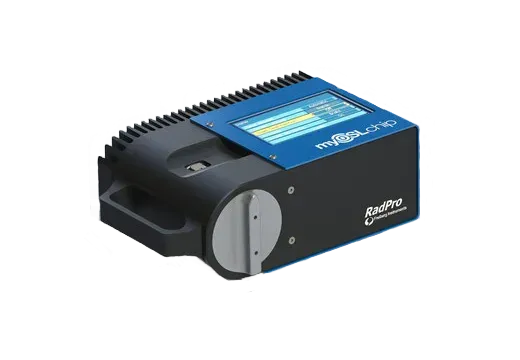
- Compatible with the myOSLchip handheld reader for autonomous or PC-controlled read-out
- Available through Saxsons Group with full AERB import documentation
Technical Specifications
| Detector material | Beryllium oxide (BeO), Z_eff 7.21, density 2.85 g/cm³ |
| Element dimensions | 4.7 × 4.7 × 0.5 mm |
| Housing | 9.5 × 10 × 2 mm ABS light-tight enclosure |
| Dose range (validated) | 0.1 – 20 Gy |
| Linearity correction | −0.5% to +3% across 0.1–20 Gy (Kowalski 2025) |
| Dose-rate dependence | None across 100–2500 MU/min |
| Energy response (photon) | −4.5% (2.5 MV FFF) to +4.5% (15 MV), relative to 6 MV |
| Energy response (electron) | +1.9% (6 MeV) to +4.3% (20 MeV) |
| Angular response | −2.02% ± 0.45% at 90° vs en-face (6 MV) |
| Signal depletion / read | −2.13% ± 0.20% average per read-out |
| Element sensitivity drift | ~−2% from 0–15 Gy cumulative, then stable to 32 Gy |
| MR safety | MR-safe (no metallic components) |
| Compatible reader | myOSLchip handheld reader / eraser |
| Applications | In-vivo dosimetry, TBI, TSET, electrons, out-of-field, pacemaker dose checks, research |
Clinical Applications
In-vivo dosimetry — one detector, many techniques
In-vivo patient dosimetry
Entrance- or exit-dose verification during external-beam radiotherapy. Validated against AAPM TG-191 in 2025 clinical commissioning studies.
TBI & TSET monitoring
Davis 2025 demonstrated equal-or-better performance vs Landauer nanoDot in total-body irradiation and total-skin electron therapy in-vivo measurements.
Pacemaker dose checks
Out-of-field dose verification at implanted device locations — small form factor places the dosimeter at the device without distorting the treatment.
Out-of-field measurement
Low-dose tail measurements outside the treatment field. BeO's Z_eff and small form factor make it a natural fit for organ-at-risk in-vivo points.
Electron beam in-vivo
Validated for 6–20 MeV electrons. En-face placement on superficial targets — common in head-and-neck and skin treatments.
Treatment-plan QC & research
Independent dose verification for new IMRT/VMAT plans or research protocols. Reusable detectors keep per-measurement cost low.
Why myOSL™ Chip?
Beryllium oxide has a Z_eff of 7.21 and density of 2.85 g/cm³, closer to tissue than Al2O3:C-based dosimeters. That translates to less energy-dependent correction across the photon and electron beams used in modern radiotherapy.
The Kowalski 2025 and Davis 2025 papers commissioned the myOSLchip against AAPM TG-191 — the same protocol clinics already use for OSL in-vivo dosimetry. No re-design needed; calibration factors are characterised across photon (2.5 MV FFF to 15 MV) and electron (6–20 MeV) beams.
Beam-quality correction kQ ranges from −4.5% at 2.5 MV FFF to +4.5% at 15 MV (relative to 6 MV). Dose-rate response is flat across 100–2500 MU/min — covering both conventional and FFF treatment deliveries.
Catalogs & Resources
Manufacturer datasheets and ordering information. Peer-reviewed validation papers are on the Knowledge Hub — link above.
myOSL™ Chip
More for this product
Each card opens a focused post for a specific specialty — peer-reviewed evidence and clinical workflow, written for the persona you select.
For Medical Physicist
Type-test dossier
Linearity to 10 Sv, fading at 3 months, energy & angular response — the manufacturer type-test data in one page.
Read thisMedical PhysicistmyOSL Chip vs MOSFET dosimeters
MOSFETs need replacement every 200–400 Gy and most readers max out at 5 channels per module. What changes when you switch to BeO OSL?
Read thisMedical PhysicistWhy BeO OSL fits TBI dosimetry
TBI needs 8–10+ in-vivo points across a long fraction. Where does the myOSL Chip line up with the workflow — and what does the peer-reviewed evidence say?
Read thisFAQ
OSL in-vivo dosimetry — questions we hear from Indian medical-physicist teams
Why the nanoDot discontinuation left a workflow gap, why BeO fits the drop-in role, which clinical measurements myOSL Chip is used for, and MR-linac compatibility.
Q.Landauer discontinued the nanoDot — what fills the in-vivo OSL gap for Indian radiotherapy departments?
The nanoDot Al₂O₃:C dosimeter was the workhorse for in-vivo dose verification and out-of-field measurement for over a decade; its discontinuation left many Indian departments without an equivalent OSL chip in the same form factor. myOSL Chip is a beryllium-oxide (BeO) OSL dosimeter designed as a direct workflow replacement — same order of magnitude sensitivity, same handling model, and it plugs into departments that already run OSL-based in-vivo QA.
Q.Why BeO instead of Al₂O₃:C for the sensor material?
BeO has near-tissue equivalence (Z_eff ≈ 7.14 vs tissue 7.4) so the energy-response curve stays flat across kV and MV without the aggressive over-response that Al₂O₃:C shows below 100 keV. That matters when the same chip has to read a diagnostic kV out-of-field dose and a 6 MV in-field dose without a per-beam calibration factor swap. BeO is also non-hygroscopic — it does not need conditioning after storage in a humid Indian summer.
Q.What problems does myOSL Chip actually solve in daily clinical practice?
Four routine workflows: (1) in-vivo entrance/exit dose verification on TBI and TSET treatments where a diode or ion chamber is impractical on a moving patient; (2) out-of-field dose measurement for organs at risk outside the planning target volume (thyroid, gonad, fetal); (3) implanted-device dose measurement (pacemakers, ICDs) where the AAPM TG-203 audit requires a documented cumulative dose; (4) commissioning-audit dose verification for new SBRT and SRS programmes where an independent measurement is a regulatory requirement.
Q.Is myOSL Chip MR-safe? Can it be used inside an MR-linac beam?
Yes. The chip is entirely non-metallic — BeO sensor bonded in a small plastic housing — with no ferromagnetic components. It is MR-safe and has been used in MR-linac in-field measurements. This is one place where Al₂O₃:C nanoDot users had no drop-in path when the MR-linac came in; myOSL Chip closes that gap.
Q.How is the reader / reading workflow supported for departments new to OSL?
myOSL Chip is read on a small dedicated OSL reader that fits on a physicist bench (no dedicated dark room, no dedicated dosimetry lab). Saxsons supplies the chip, the reader, the calibration set and applications training as a single package — the department signs one PO and starts running in-vivo OSL within the same commissioning cycle.
myOSL Chip supplier in India — Saxsons Group
Saxsons Group has supplied dosimetry equipment to over 1,000 Indian hospitals since 1988. Every consignment of myOSL Chip ships with cold-chain logistics, AERB import documentation, CDSCO registration references and a Certificate of Analysis delivered before dispatch — the paperwork your radiation-safety and procurement teams need, pre-assembled.
- Nationwide delivery footprint — every metro and tier-2 city in India, scheduled to your treatment / procedure calendar.
- AERB & CDSCO documentation — import licence, radiation-safety paperwork and RSO briefing pre-assembled for the audit file.
- 40+ years in Indian oncology — long-standing supply relationships with AIIMS, Tata Memorial, and hundreds of tertiary-care centres.
- Single point of accountability — one purchase order, one delivery contact, one after-sales team across the whole product family.
Switching from nanoDot? Or adding OSL in-vivo for the first time?
Contact Saxsons Group for pricing on the myOSL Chip dosimeter (DM-005), the myOSLchip handheld reader, demo arrangement, AERB import documentation and installation support.