
Authorised Indian Distributor
Saxsons Group
New Delhi, India · Since 1997
Radiation Display UnitLocal Touchscreen Display for Up to Four Detectors
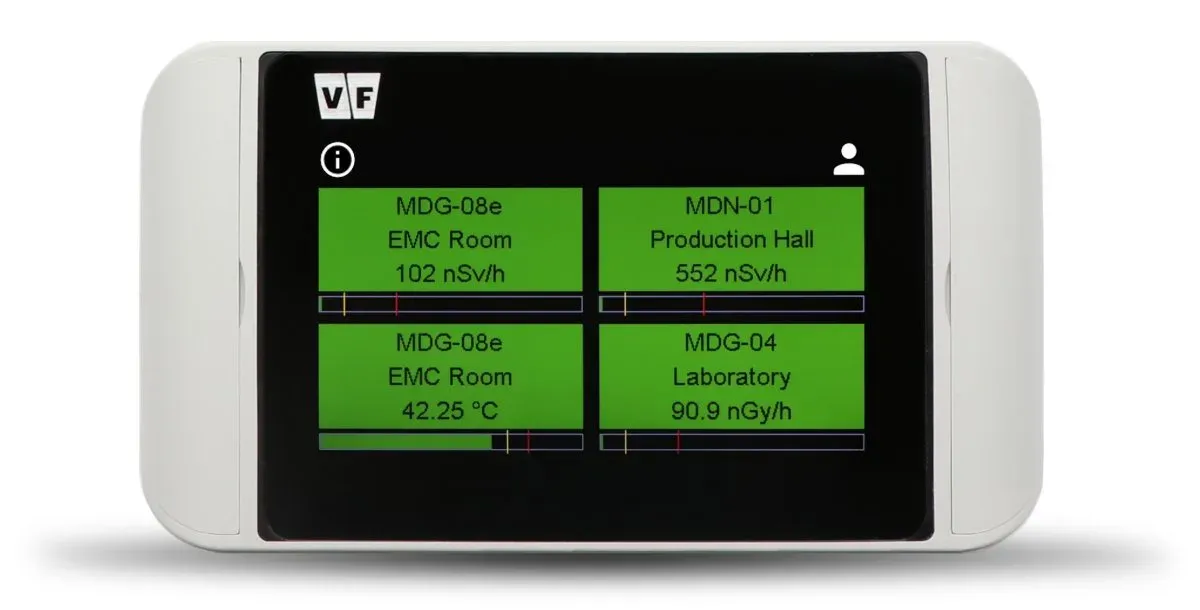
Compact local display unit for radiation-monitoring systems. Up to four detectors connect directly via Ethernet or RS-485; the unit displays current values, signals alarm threshold crossings on integrated audible / visual alarms, and forwards the cluster to the central RMS server. 5,000-value local archive ensures the data survives a host-network outage. Ruggedised variant available for harsher install locations.
Key Features
- Compact local display unit intended for use in radiation monitoring systems
- Up to four detectors connect directly via Ethernet or RS-485 — no separate detector hub needed for the cluster
- Forwards aggregated cluster data to the host RMS server via Ethernet — one cable upstream covers four detectors downstream
- User-friendly colour touchscreen display — current values, alarm states, threshold settings, audit log
- Integrated visual and audible alarms with capability to drive external alarm units (warning lights, sirens, area annunciators)
All Features
- Compact local display unit intended for use in radiation monitoring systems
- Up to four detectors connect directly via Ethernet or RS-485 — no separate detector hub needed for the cluster
- Forwards aggregated cluster data to the host RMS server via Ethernet — one cable upstream covers four detectors downstream
- User-friendly colour touchscreen display — current values, alarm states, threshold settings, audit log
- Integrated visual and audible alarms with capability to drive external alarm units (warning lights, sirens, area annunciators)
- Local archive of up to 5,000 values with adjustable storage period from 10 seconds — survives a brief network outage to the central RMS
- Supports sending preset commands from the display unit directly to the connected detectors — local control without trips back to the RMS console
- Ruggedised variant for harsher mounting locations (vault corridors, hot-lab egress points, outdoor sheds)
- Applicable across nuclear facilities, waste management, ionizing radiation metrology, environmental monitoring, nuclear medicine and non-nuclear industry
- Engineered as a cluster aggregator — fits naturally into the RMS architecture as the second-tier device between field detectors and the central server
- AERB-compliant deployment paperwork supplied
- Documentation: datasheet, commissioning records, AERB compliance paperwork
Technical Specifications
| Product role | Local touchscreen display + cluster aggregator for up to four field detectors |
| Detector connectivity | Up to 4 detectors per unit; Ethernet or RS-485 direct connection |
| Host connectivity | Ethernet uplink to RMS server |
| Display | Colour graphic touchscreen |
| Alarms | Integrated visual + audible alarms; external alarm-unit driver outputs |
| Local archive | 5,000 values per channel; storage period adjustable from 10 s upwards |
| Local commands | Preset commands from the display unit dispatched directly to connected detectors |
| Variants | Standard; ruggedised version for harsher mounting locations |
| Application areas | Nuclear facilities, waste management, ionizing-radiation metrology, environmental monitoring, nuclear medicine, non-nuclear industry |
| AERB framework | Site-deployment paperwork aligned to AERB radiation-safety expectations |
Applications
The cluster-level display between field detectors and the central RMS
Vault corridor cluster
Four area gamma monitors covering the cyclotron vault corridor — one display unit shows the cluster at the vault-control panel, aggregates the data upstream and triggers local annunciation when any monitor crosses an alarm threshold.
Hot-lab quadrant
Four detectors around a hot-lab quadrant (above the dispensing bench, at the dose-calibrator, at the QC station, at egress). The display unit gives the radiopharmacist a single touchscreen showing the immediate working-area dose-rate field.
Theranostic ward
Four area monitors on the four-room Lu-177 / I-131 theranostic ward — one display unit at the nursing station shows the ward field continuously. Ward staff see the dose-rate context without leaving the station.
Stack + adjacent contamination
Mixed cluster: stack monitor + contamination frisker at egress + two area gamma monitors. The display unit shows all four at the radiation-safety officer's desk for site walk-down monitoring.
Outdoor monitor cluster
Four area gamma monitors at perimeter points around the facility. The ruggedised variant in an outdoor enclosure displays the perimeter cluster for facility-security and emergency-response use.
Network-outage resilience
When the central RMS server is offline for maintenance, the display unit continues to display, archive and alarm. The 5,000-value local archive ensures the dose-rate record is preserved through the outage and synchronises to the RMS on reconnection.
Why Radiation Display Unit?
Without a cluster aggregator, every field detector needs its own cable run to the central RMS — expensive, fragile, hard to extend. The display unit aggregates four detectors locally and runs one Ethernet uplink to the server. New detectors join the cluster without disturbing the upstream cable path.
When the central RMS server is down for maintenance or the building network drops, the display unit continues to display, alarm and archive. The 5,000-value buffer covers a meaningful outage; on reconnection the cluster history flows up to the server with no gap in the dose-rate record.
A vault corridor, a hot-lab clean-room boundary, an outdoor perimeter monitor cluster — these are not benign environments for a touchscreen. The ruggedised variant's housing means the display can sit where the cluster sits, not where the building HVAC permits the standard unit.
Catalogs & Resources
Manufacturer product page. Contact Saxsons for AERB documentation, cluster architecture and India installation.
Display Unit
More for this product
Each card opens a focused post for a specific specialty — peer-reviewed evidence and clinical workflow, written for the persona you select.
FAQ
Corridor radiation display unit — questions we hear from Indian cyclotron RSOs
Why the worker needs a visible dose-rate display at the boundary rather than only at the fixed monitor, what the touchscreen shows, how the RDU-02 aggregates four detectors, and where to place it in the facility layout.
Q.What is a Radiation Display Unit and why does a cyclotron facility need one at strategic corridor locations?
Area gamma monitors and neutron monitors sit at fixed points inside the shielded areas — the actual measurement point is often behind a shielded wall from anyone walking past. A Radiation Display Unit is a touchscreen display that shows the live readings from up to four nearby detectors, sited at corridor entry points, hot-lab doors and vault-access doors so anyone approaching the shielded area sees the current dose rate before entering. AERB Regulatory Requirements for Medical Cyclotron Facility expect visible-to-the-worker dose-rate indicators at controlled-area boundaries.
Q.What does the operator see on the display?
Real-time dose rate from each of the four connected detectors, colour-coded against the department's pre-configured alarm thresholds (green / yellow / red). Cumulative dose over the configurable window. Alarm state on each channel with time-since-alarm-onset. Touchscreen navigation for acknowledgement and history-view.
Q.How does the RDU-02 integrate with the AGM-03, PET-01 and neutron monitors?
The RDU-02 is a cluster-architecture display — it aggregates readings from up to four nearby detectors (typically an area gamma monitor, neutron monitor, stack monitor and a hand-foot monitor at a facility choke point) into one visible dashboard. The upstream monitors also feed the central RMS server independently; the RDU-02 provides the on-wall visibility at the entry point where the worker actually needs it.
Q.Where in the facility does the RDU-02 typically get installed?
Vault-access door (dose rate before entering the beam room), hot-lab door (dose rate before entering the dispensing area), radiopharmacy corridor (dose rate at the walking route between synthesis and dispensing), and inspection-room entry (dose rate before entering an active PET scan room). Placement is per-facility against the AERB dossier controlled-area layout.
Q.How is the RDU-02 supplied and installed in India?
Distributed across India by Saxsons Group. Supply covers the display unit, cluster architecture design (which detectors feed which RDU-02), site-fit assessment, RMS integration and India commissioning support.
Radiation Display Unit supplier in India — Saxsons Group
Saxsons Group has supplied cyclotron equipment to over 1,000 Indian hospitals since 1988. Every consignment of Radiation Display Unit ships with cold-chain logistics, AERB import documentation, CDSCO registration references and a Certificate of Analysis delivered before dispatch — the paperwork your radiation-safety and procurement teams need, pre-assembled.
- Nationwide delivery footprint — every metro and tier-2 city in India, scheduled to your treatment / procedure calendar.
- AERB & CDSCO documentation — import licence, radiation-safety paperwork and RSO briefing pre-assembled for the audit file.
- 40+ years in Indian oncology — long-standing supply relationships with AIIMS, Tata Memorial, and hundreds of tertiary-care centres.
- Single point of accountability — one purchase order, one delivery contact, one after-sales team across the whole product family.
Also supplied by Saxsons Group across India
Aggregate field detectors at the cluster, not at the server
Contact Saxsons Group for radiation display unit supply, AERB compliance paperwork and India commissioning support.