
Authorised Indian Distributor
Saxsons Group
New Delhi, India · Since 1997
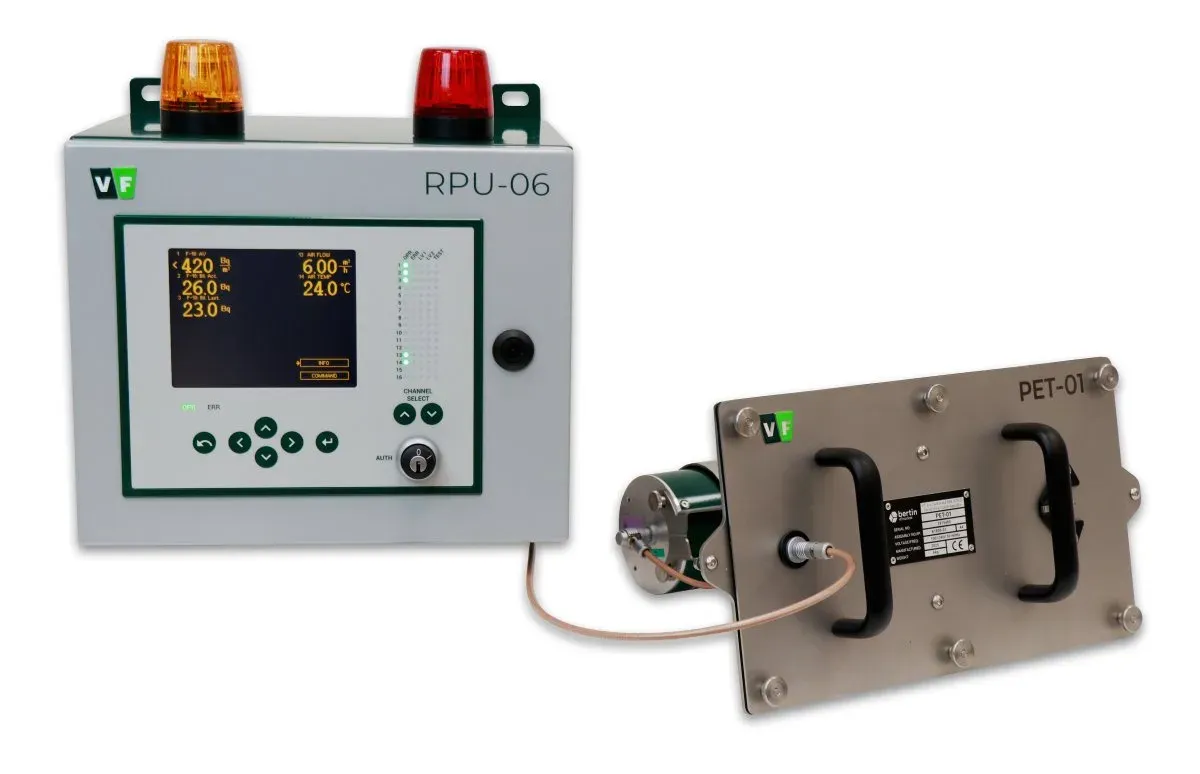
Stack / Effluent MonitorGaseous Effluent Air Monitor for PET Cyclotron Facilities
Monitoring of gaseous effluents at facilities that produce, process and use positron-emitting radionuclides. NaI(Tl) GD-53 gamma detector installed inside or beside the ventilation duct, with optional collimator. A spectroscopic multichannel-analyser variant supports isotope identification from the stack spectrum itself. Pairs with the RMS server for site-wide release-monitoring records.
Key Features
- Monitoring of gaseous effluents in facilities producing, processing and using positron-emitting radionuclides
- Targets cyclotron facilities, PET centres and nuclear-medicine departments dispensing positron-emitting radiopharmaceuticals
- NaI(Tl) scintillation detector (GD-53) optimised for the 511 keV annihilation-photon spectrum of positron emitters
- Installation flexibility: detector mounted inside the ventilation duct for maximum sensitivity, or adjacent to the duct with optional collimator for easier service access
- Baseline variant: DIM-09 multichannel analyser (1K channels with region-of-interest analysis)
All Features
- Monitoring of gaseous effluents in facilities producing, processing and using positron-emitting radionuclides
- Targets cyclotron facilities, PET centres and nuclear-medicine departments dispensing positron-emitting radiopharmaceuticals
- NaI(Tl) scintillation detector (GD-53) optimised for the 511 keV annihilation-photon spectrum of positron emitters
- Installation flexibility: detector mounted inside the ventilation duct for maximum sensitivity, or adjacent to the duct with optional collimator for easier service access
- Baseline variant: DIM-09 multichannel analyser (1K channels with region-of-interest analysis)
- Spectroscopic variant: DIM-15 multichannel analyser (1K, 2K, 4K or 8K channels) with built-in peak analysis — isotope identification from the spectrum itself
- Local display and control on the unit, with full integration into the host RMS server
- Sustained continuous monitoring across cyclotron production cycles — the release record runs through the production day and the decay tail
- Alarm thresholds configurable per-isotope for release-rate exceedances
- AERB-compliant stack-release record — the inspection-ready release log
- Pairs with environmental and area monitors on the same RMS server for the complete radiation-safety dossier
- Documentation: datasheet, commissioning records, calibration certificate, AERB compliance paperwork
Technical Specifications
| Intended use | Monitoring of gaseous effluents in PET production, cyclotron facility and nuclear-medicine release stacks |
| Target isotopes | Positron-emitting radionuclides via 511 keV annihilation photons (F-18, C-11, O-15, N-13, Ga-68 and related) |
| Detector type | NaI(Tl) scintillation gamma detector (GD-53) |
| Installation | Inside ventilation duct (maximum sensitivity) or adjacent to duct with optional collimator (easier service access) |
| Baseline MCA | DIM-09 multichannel analyser, 1K channels with region-of-interest analysis |
| Spectroscopic MCA | DIM-15 multichannel analyser, 1K / 2K / 4K / 8K channels with built-in peak analysis |
| Local control | On-board display and control; integrates into host RMS server |
| Alarm management | Per-isotope configurable thresholds; alarm events streamed to RMS server |
| Host interface | LAN / RS-485 (per manufacturer datasheet) |
| AERB framework | AERB-compliant stack-release record for inspection |
Applications
The continuous release record AERB inspection expects
PET cyclotron facility stack
Cyclotron F-18 production releases trace activity through the building exhaust. The stack monitor sits at the duct and produces the continuous release record AERB inspection expects.
Hot-lab fume hood exhaust
Radiopharmacy hot-cells and fume hoods are exhausted through dedicated ducts. The spectroscopic variant identifies which isotope is in the release stream — useful when a contamination event needs root-cause analysis.
Theranostic centre release
Lu-177 / Ga-68 dispensing produces aerosol activity in the local exhaust. The stack monitor detects the activity above background and triggers alarm when the release rate crosses the regulatory threshold.
Annual stack-release dossier
AERB facility licence renewal includes the annual stack-release record. The stack-monitor + RMS archive provides the data; the radiation-safety officer summarises the dossier from continuous data rather than from operator estimation.
Production cycle correlation
A cyclotron production cycle generates a characteristic stack-release signature. The stack-monitor log correlated with the production-day log lets the radiopharmacy verify that releases match expected production yields.
Incident detection
A failed cell-isolation valve or an unexpected hot-lab contamination produces an out-of-pattern stack-release spike. The stack monitor catches the spike in real time and triggers the RMS escalation chain.
Why Stack / Effluent Monitor?
Positron-emitter facilities release 511 keV annihilation photons. A NaI(Tl) crystal sits at the right efficiency-vs-cost point for 511 keV stack monitoring — sensitive enough to read trace release rates above background, cost-effective enough for continuous unattended deployment.
Cyclotron building duct routes are not always service-accessible. The stack monitor supports either in-duct installation for maximum sensitivity or adjacent-duct installation with an optional collimator for sites where in-duct mounting is impractical. The same instrument serves either deployment.
A simple counts-vs-time stack monitor flags that a release happened. The spectroscopic MCA variant — up to 8K channels with built-in peak analysis — identifies which isotope is in the release stream from the spectrum. Useful when the release record has to differentiate routine F-18 against an unexpected longer-lived contaminant.
Catalogs & Resources
Manufacturer product page. Contact Saxsons for AERB documentation, site survey and India installation.
Stack / Effluent Monitor
More for this product
Each card opens a focused post for a specific specialty — peer-reviewed evidence and clinical workflow, written for the persona you select.
FAQ
PET cyclotron stack / effluent monitor — questions we hear from Indian cyclotron teams
What airborne activity leaves a PET cyclotron stack, why continuous monitoring catches release bursts periodic sampling misses, what the RMS export looks like at AERB inspection, and how the stack monitor fits the RMS server.
Q.What does a stack effluent monitor measure at a PET cyclotron facility?
A cyclotron produces radioactive gases during F-18 target processing (trace [18F]-fluoride carried in helium purge), radiochemistry (volatile [11C] and [13N] by-products) and off-gas handling. Even after passing through the WGHS decay-and-release chain, small amounts of activity reach the building exhaust stack. AERB Regulatory Requirements for Medical Cyclotron Facility set continuous stack-release monitoring as a licensing requirement — the department must document what leaves the stack every operating day.
Q.Why continuous stack monitoring rather than periodic sampling?
Cyclotron production releases short bursts of activity when the synthesis reactor purges and the WGHS decay-tank releases — not a steady state. Periodic sampling misses those bursts entirely and produces an under-reported facility release. Continuous stack monitoring captures every release event and produces the day-by-day trend that AERB inspection reads to verify the facility is releasing within its licensed envelope.
Q.What does the archive look like at inspection?
Continuous dose-rate / activity-concentration trend at the stack, timestamped, with alarm events flagged and acknowledged. The RMS export produces the trend across the inspection window — a clean data file the inspector reads directly, rather than a stack of paper printouts the operator has to reconstruct.
Q.How does the stack monitor integrate with the rest of the RMS?
PET-01 stack monitor feeds into the central RMS server alongside area gamma monitors, neutron monitors and hand-foot monitors. All facility radiation measurements sit in one central database; the RMS export at inspection covers every channel, every event, every alarm acknowledgement — the audit trail is one file, not multiple paper logs.
Q.How is the stack monitor supplied and installed in India?
Distributed across India by Saxsons Group. Supply covers the stack monitor, site-survey against the facility exhaust geometry, RMS integration, commissioning against AERB Regulatory Requirements for Medical Cyclotron Facility and India commissioning support.
Stack / Effluent Monitor supplier in India — Saxsons Group
Saxsons Group has supplied cyclotron equipment to over 1,000 Indian hospitals since 1988. Every consignment of Stack / Effluent Monitor ships with cold-chain logistics, AERB import documentation, CDSCO registration references and a Certificate of Analysis delivered before dispatch — the paperwork your radiation-safety and procurement teams need, pre-assembled.
- Nationwide delivery footprint — every metro and tier-2 city in India, scheduled to your treatment / procedure calendar.
- AERB & CDSCO documentation — import licence, radiation-safety paperwork and RSO briefing pre-assembled for the audit file.
- 40+ years in Indian oncology — long-standing supply relationships with AIIMS, Tata Memorial, and hundreds of tertiary-care centres.
- Single point of accountability — one purchase order, one delivery contact, one after-sales team across the whole product family.
Also supplied by Saxsons Group across India
Anchor your stack-release record on continuous monitoring
Contact Saxsons Group for stack / effluent monitor supply, AERB compliance paperwork, site survey and India commissioning.