
Authorised Indian Distributor
Saxsons Group
New Delhi, India · Since 1997
FDGtwo™ RadiosynthesizerAutomated F-18 Synthesis Module · Two Batches, One Setup
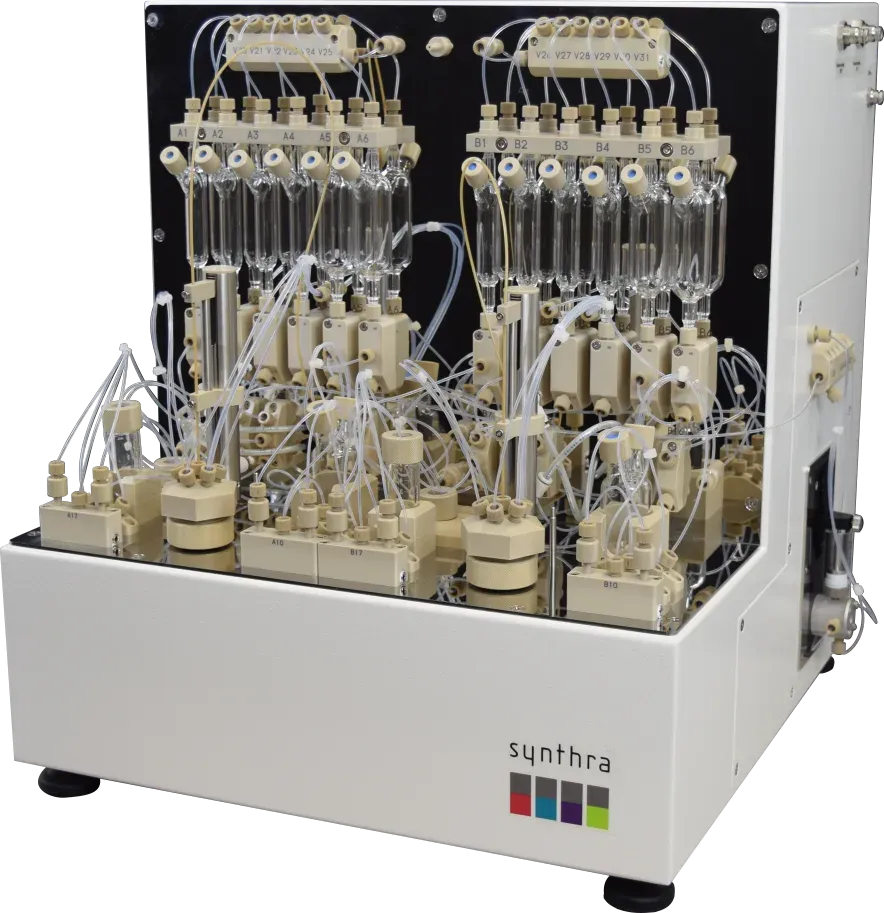
Two independent reaction-vessel sets inside one synthesis module — two [18F]FDG productions from a single setup, plus the chemistry headroom for FMISO, FLT, FCh and other nucleophilic [18F] tracers. Basic hydrolysis under 28 minutes, radiochemical purity above 98 %, guaranteed RCY 65–85 %.
Key Features
- Two independent sets of a single synthesis unit — two [18F]FDG productions with one setup (per manufacturer spec)
- Multi-tracer chemistry — [18F]FDG, [18F]FMISO, [18F]FLT, [18F]FCh and other nucleophilic [18F] compounds (per manufacturer spec)
- Synthesis time: basic hydrolysis < 28 minutes; acid hydrolysis < 22 minutes (per manufacturer spec)
- Radiochemical purity > 98 %; guaranteed RCY 65–85 % under optimal conditions (per manufacturer spec)
- Two closed glassy-carbon reaction vessels — 11 mL each, RT to 200 °C with integrated air cooling
All Features
- Two independent sets of a single synthesis unit — two [18F]FDG productions with one setup (per manufacturer spec)
- Multi-tracer chemistry — [18F]FDG, [18F]FMISO, [18F]FLT, [18F]FCh and other nucleophilic [18F] compounds (per manufacturer spec)
- Synthesis time: basic hydrolysis < 28 minutes; acid hydrolysis < 22 minutes (per manufacturer spec)
- Radiochemical purity > 98 %; guaranteed RCY 65–85 % under optimal conditions (per manufacturer spec)
- Two closed glassy-carbon reaction vessels — 11 mL each, RT to 200 °C with integrated air cooling
- Six shielded radiation detectors for in-process activity monitoring across the synthesis path
- Built-in self-cleaning system — 45-minute cleanup cycle between productions
- High-resolution dispenser — 5 mL syringe, 0–24,000 step resolution
- Manual and automatic operation modes; user-defined synthesis variations via the proprietary GUI
- Compact footprint — 42 × 50 × 48 cm (W × D × H), ~25 kg, fits a 55 × 55 × 50 cm minimum hot-cell envelope
- Drops into a SYNT-class synthesis hot cell; pairs with FLEX for downstream dispensing and WGHS for off-gas handling
- Available through Saxsons Group with full AERB import documentation
Technical Specifications
| Type | Automated F-18 radiosynthesizer (nucleophilic-substitution chemistry) for cyclotron radiopharmacy |
| Primary tracer | [18F]FDG — basic hydrolysis < 28 min, acid hydrolysis < 22 min |
| Other tracers supported | [18F]FMISO, [18F]FLT, [18F]FCh and other nucleophilic [18F] compounds (per manufacturer spec) |
| Radiochemical purity | > 98 % (per manufacturer spec) |
| Yield | Guaranteed RCY 65–85 % under optimal conditions |
| Max starting activity | 1110 GBq (30 Ci) per run |
| Reaction vessels | Two closed glassy-carbon units, 11 mL volume, room temperature to 200 °C |
| Temperature control | Integrated air cooling |
| In-process monitoring | Six shielded radiation detectors across the synthesis path |
| Dispenser | 5 mL syringe; 0–24,000 step resolution |
| Cleanup time | 45 minutes (built-in self-cleaning cycle) |
| Independent synthesis sets | Two — supports two [18F]FDG batches with one setup |
| Operation modes | Manual + automatic; user-defined synthesis-protocol editor |
| Software | Proprietary graphical user interface (GUI) with customisable protocols |
| Dimensions | 42 × 50 × 48 cm (W × D × H) |
| Weight | ~25 kg |
| Minimum hot-cell envelope | 55 × 55 × 50 cm (W × D × H) — fits a SYNT-class synthesis cell |
| Pairing | SYNT synthesis hot cell (host) → FLEX dispensing hot cell (downstream) → WGHS off-gas handling |
| Indian regulatory path | AERB Atomic Energy (Radiation Protection) Rules 2004 + AERB Regulatory Requirements for Medical Cyclotron Facility (2017); GMP recipe and Pharm.Eur. monograph release sit with the radiopharmacy |
Applications
Two-batches-per-setup F-18 production for a multi-tracer cyclotron radiopharmacy
[18F]FDG production — two batches per setup
The two-vessel architecture turns one operator setup into two consecutive [18F]FDG batches. For an Indian PET centre running back-to-back morning lists, that halves the dispense-prep overhead per patient batch and keeps the radiochemist away from a second handling cycle on the same shift.
Multi-tracer cyclotron radiopharmacy
Beyond FDG, the module covers [18F]FMISO (hypoxia imaging), [18F]FLT (proliferation), [18F]FCh (prostate and HCC choline imaging) and other nucleophilic [18F] chemistries. One synthesis module supports the tracer menu a tertiary PET-CT centre typically wants to expand into without adding a second cabinet.
Fits a SYNT-class synthesis cell
At 42 × 50 × 48 cm and ~25 kg, the module is sized for the SYNT synthesis hot cell envelope (55 × 55 × 50 cm minimum). The radiopharmacy stack — synthesis cell, synthesizer, dispensing cell, off-gas handler — is sourced as one chain with a single AERB import file.
In-process radiation monitoring
Six shielded radiation detectors track activity at multiple points across the synthesis path. The chemistry is observable in real time rather than as a single end-of-run yield reading, which makes the cause of a low-yield batch easier to trace.
Self-cleaning between productions
A 45-minute built-in cleanup cycle prepares the system for the next run without manual intervention. Combined with the two-vessel architecture, the workflow is: setup → batch 1 → batch 2 → self-clean → ready for tomorrow.
Indian PET-radiopharmacy fit
Sits inside the AERB Regulatory Requirements for Medical Cyclotron Facility (2017) licensing path. Supplied with the import documentation an Indian cyclotron site needs; GMP recipe authorship, batch-release QC and Pharm.Eur. monograph compliance remain with the site radiopharmacy.
Why FDGtwo?
The module holds two independent reaction-vessel sets. After one setup the operator can run two consecutive [18F]FDG batches — the headline workflow advantage for any site running back-to-back PET lists. The second batch does not require a second setup.
Radiochemical purity above 98 % and guaranteed yield 65–85 % under optimal conditions — published specification from the manufacturer. The synthesis path is monitored at six shielded detectors so a low-yield batch can be traced rather than just observed.
Under 28 minutes for basic hydrolysis and under 22 minutes for acid hydrolysis — the synthesis window stays inside one F-18 half-life (109.8 min) with plenty of margin for QC, dispensing and patient injection downstream.
Catalogs & Resources
Manufacturer product page. Manufacturer brochure available on request — contact Saxsons for direct delivery.
FDGtwo™ Radiosynthesizer
More for this product
Each card opens a focused post for a specific specialty — peer-reviewed evidence and clinical workflow, written for the persona you select.
For Radiopharmacist
One setup, two batches — but two batch records
The two-vessel architecture saves the second setup, not the second Pharm.Eur. release. Three columns: shared per session, per batch, session closure — plus four SOP guard-rails.
Read thisRadiopharmacistWhy FDGtwo maps cleanly onto the cyclotron GMP stack
Annex 3 + Annex 11 + AERB + Pharm.Eur. — four overlapping rule-sets the F-18 synthesizer has to fit inside. Sourced requirement→feature map plus four distinctive engineering features against the single-vessel baseline.
Read thisFAQ
F-18 synthesis, multi-tracer PET production — questions we hear from Indian cyclotron teams
Why single-batch synthesis is a bottleneck for busy PET centres, how the two-vessel design doubles throughput per setup, multi-tracer support (FDG / FMISO / FLT / FCh), and how FDGtwo fits into a SYNT-class host cell.
Q.Why is one F-18 batch per synthesis setup a bottleneck for busy PET centres?
A single-vessel F-18 synthesizer produces one FDG batch per setup — the cassette, the reagent kit and the QC cycle all consume 30–45 minutes per batch of turnaround before the next batch can start. For a centre running 40+ FDG patients per morning across multiple satellite hospitals, one batch per setup means multiple synthesis runs, multiple cassettes, and the F-18 decays away between batches. The bottleneck is the synthesizer, not the cyclotron.
Q.How does FDGtwo double batch throughput without doubling the footprint?
FDGtwo is a two-vessel F-18 synthesis module — two independent reactor + purification lines inside one enclosure. One synthesis setup and one cassette produce two [18F]FDG batches from a single target load. Same synthesizer footprint, same operator time, same QC cycle applied to both batches — the F-18 activity budget stretches across a bigger patient list without a second cyclotron shot.
Q.Does FDGtwo handle non-FDG F-18 tracers as well?
Yes. The module is multi-tracer capable — FDG, FMISO (hypoxia PET), FLT (proliferation PET) and F-Choline (prostate PET) chemistry runs on the same platform with the corresponding cassette + reagent kit. A single synthesizer covers the primary and specialist PET programme without a second module.
Q.Which host synthesis cell fits FDGtwo?
FDGtwo is sized for a SYNT-class synthesis hot cell. At 42 × 50 × 48 cm and around 25 kg the module fits inside the SYNT 55 × 55 × 50 cm envelope. The radiopharmacy stack — SYNT cell + FDGtwo synthesizer + FLEX dispensing cell + WGHS off-gas handler — is sourced as one chain from Saxsons with a single AERB import file.
Q.How is FDGtwo supplied and installed in India?
FDGtwo is distributed by Saxsons Group. Supply covers the module, cassette + reagent kit compatibility, integration with the SYNT host cell, multi-tracer chemistry configuration, and the AERB Regulatory Requirements for Medical Cyclotron Facility documentation dossier. Saxsons handles the CDSCO medical-device import registration and installation across the Indian cyclotron network.
FDGtwo Radiosynthesizer supplier in India — Saxsons Group
Saxsons Group has supplied cyclotron equipment to over 1,000 Indian hospitals since 1988. Every consignment of FDGtwo Radiosynthesizer ships with cold-chain logistics, AERB import documentation, CDSCO registration references and a Certificate of Analysis delivered before dispatch — the paperwork your radiation-safety and procurement teams need, pre-assembled.
- Nationwide delivery footprint — every metro and tier-2 city in India, scheduled to your treatment / procedure calendar.
- AERB & CDSCO documentation — import licence, radiation-safety paperwork and RSO briefing pre-assembled for the audit file.
- 40+ years in Indian oncology — long-standing supply relationships with AIIMS, Tata Memorial, and hundreds of tertiary-care centres.
- Single point of accountability — one purchase order, one delivery contact, one after-sales team across the whole product family.
Also supplied by Saxsons Group across India
Add two-batches-per-setup F-18 synthesis to your cyclotron radiopharmacy
Contact Saxsons Group for pricing, SYNT-host configuration, multi-tracer chemistry options, demo arrangement, AERB import documentation and installation support for the FDGtwo radiosynthesizer.