
Authorised Indian Distributor
Saxsons Group
New Delhi, India · Since 1997
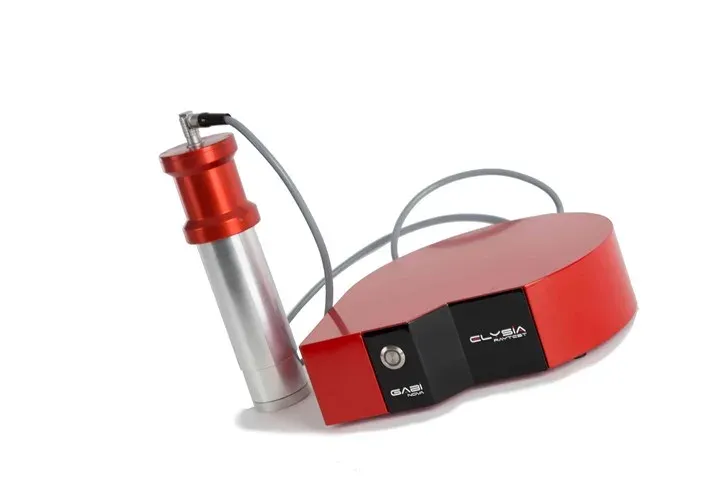
GABI NovaRadio-HPLC Flow Detector — Radiochemical-Purity Release Across SPECT + PET
Online radioactivity flow detector for radio-HPLC radiopharmaceutical QC. Swap-in scintillator probe options match the isotope energy — Tc-99m at 140 keV, F-18 / Ga-68 at 511 keV, Lu-177 at 113 / 208 keV. Lead-castle background shielding. Adjustable flow-cell volumes for different activities and flow rates. Eur.Ph. / USP <823> %RCP release on the HPLC chromatogram, 21 CFR Part 11 audit trail.
Key Features
- Online radioactivity flow detection — continuous radio-HPLC chromatogram, not offline batch counts
- Swap-in scintillator probe options match isotope energy: low (Tc-99m / I-131), medium (Lu-177), high (F-18 / Ga-68 / Cu-64)
- PMT and digital detection front-ends — sensitivity-vs-dynamic-range trade-off configured per site
- Adjustable flow-cell volumes — pick the cell that matches batch activity, HPLC flow rate and resolution requirement
- Lead-castle background shielding configurable to the bench layout; protects against adjacent hot-lab activity
All Features
- Online radioactivity flow detection — continuous radio-HPLC chromatogram, not offline batch counts
- Swap-in scintillator probe options match isotope energy: low (Tc-99m / I-131), medium (Lu-177), high (F-18 / Ga-68 / Cu-64)
- PMT and digital detection front-ends — sensitivity-vs-dynamic-range trade-off configured per site
- Adjustable flow-cell volumes — pick the cell that matches batch activity, HPLC flow rate and resolution requirement
- Lead-castle background shielding configurable to the bench layout; protects against adjacent hot-lab activity
- Direct integration with standard HPLC towers — radioactive trace overlaid on the UV / PDA chromatogram in one window
- GMP / GLP design; 21 CFR Part 11 electronic records and electronic signatures for batch release
- Eur.Ph. / USP <823> radiochemical-purity calculation against per-monograph thresholds
- AERB hot-lab QC fit: instrument operates inside the radiopharmacy licence covering Tc-99m / F-18 / Ga-68 / Lu-177 handling
- Compact footprint suited to a standard 600 mm bench depth alongside the dose calibrator and radio-TLC scanner
- Documentation: datasheet, IQ / OQ / PQ protocols, calibration certificate, 21 CFR Part 11 validation evidence
Technical Specifications
| Detection principle | Online scintillation flow counting in the HPLC eluate stream |
| Detector probes | Multiple scintillator options across low / medium / high gamma-energy bands |
| Front-end | PMT or digital detection; configured per sensitivity-vs-dynamic-range trade-off |
| Flow cell | Adjustable cell volumes for analytical, prep and micro-HPLC use cases |
| Shielding | Configurable lead-castle housing; background attenuation tuned to hot-lab background |
| HPLC compatibility | Standard chromatograph integration; radioactive + UV / PDA channel overlay |
| Interface | Instrument communication protocol to QC workstation; multi-instrument session |
| Software | Eur.Ph. / USP <823> %RCP calculation, per-isotope method library, 21 CFR Part 11 audit trail |
| Compliance framework | GMP / GLP, AERB hot-lab QC, Eur.Ph. radiopharmacy monographs, USP <823>, 21 CFR Part 11 |
| Validation | IQ / OQ / PQ protocols supplied; site PQ scheduled during install |
Applications
Continuous radio-HPLC — the radiochemical-purity gold standard for the daily hot lab
Radiochemical-purity gold standard
Radio-HPLC is the gold-standard radiochemical-purity method for radiopharmaceutical release — continuous radioactivity chromatogram identifies free radionuclide, intended product and impurity peaks in a single 10–20 min run. Eur.Ph. monographs cite the radio-HPLC method explicitly for several radiopharmaceuticals.
F-18 PET tracer release
Per-batch [18F]FDG, [18F]NaF and emerging F-18 tracer release — radio-HPLC %RCP against the Eur.Ph. monograph threshold before despatch to the imaging room. High-energy probe captures the 511 keV annihilation line at HPLC flow rates.
Ga-68 PET tracer release
Per-batch Ga-68 DOTATATE / DOTATOC / PSMA-11 release from the generator-fed labelling rig — radio-HPLC catches Ga-68 colloid and uncomplexed Ga-68 that radio-TLC may not resolve at the same threshold.
Lu-177 theranostic QC
Per-batch Lu-177 DOTATATE, PSMA-617 and FAPI release — radio-HPLC complements the radio-TLC %RCP for the theranostic release record. NETTER / VISION-aligned QC programmes use both methods.
Investigator-initiated work
Investigator-initiated novel-chelator work, method development and stability studies — adjustable cell volume + swap-in probe means one instrument across a research-radiopharmacy programme.
Routine batch release
21 CFR Part 11 audit trail with electronic signatures and per-method versioning supports per-batch release documentation under AERB inspection and external GMP audit.
Why GABI Nova?
Unlike offline TLC, radio-HPLC produces a continuous radioactivity chromatogram alongside the UV / PDA trace. Free radionuclide, intended product and impurities are resolved in one 10–20 min run — the release decision and the impurity profile come off the same chromatogram.
A swap-in scintillator probe matches the isotope energy band. Tc-99m, F-18, Ga-68, Lu-177 and Cu-64 are all read on the same instrument with the appropriate probe — capital investment scales across the full radiopharmacy isotope panel without an instrument swap.
GMP / GLP design and 21 CFR Part 11 audit-trail compliance make the release record acceptable to AERB inspection and external GMP audit. Electronic signatures, method versioning, override capture — all retained per batch.
Catalogs & Resources
Pharmacopeial + IAEA references that anchor the radio-HPLC release workflow. Contact Saxsons for India pricing, install scheduling and IQ / OQ / PQ documentation.
USP <823> — Positron Emission Tomography Drugs
US Pharmacopeia general chapter for PET radiopharmacy defining radiochemical-purity test methods and the per-monograph release thresholds.
Eur.Ph. — Radiopharmaceutical Preparations general monograph
European Pharmacopoeia general + per-isotope monographs defining the radio-HPLC release method and per-product %RCP thresholds.
IAEA Operational Guidance on Hospital Radiopharmacy
IAEA framework covering hospital-radiopharmacy operational radiation protection, QC and instrument validation expectations.
GABI Nova
More for this product
Each card opens a focused post for a specific specialty — peer-reviewed evidence and clinical workflow, written for the persona you select.
FAQ
Radio-HPLC flow detector — questions we hear from Indian radiopharmacy teams
Why a standard UV detector can't release a radiopharmaceutical batch, why swap-in scintillator probes cover the SPECT-through-PET energy range, what the lead-castle shielding solves in a busy hot lab, and how the detector fits USP <823> / Eur.Ph. / 21 CFR Part 11.
Q.Why can't a radiopharmacy run radio-HPLC on a standard UV detector alone?
A standard HPLC UV detector reads absorbance — great for the labelling ligand, blind to the radioactivity. On a Lu-177-DOTATATE or Ga-68-PSMA labelling batch, the UV chromatogram shows all the DOTATATE / PSMA peaks including the un-labelled ligand. The QC question the batch release actually needs to answer is "what fraction of the radioactivity is bound to the correct peptide" — that is a radioactivity-vs-retention-time chromatogram, not a UV chromatogram. A radio-HPLC flow detector reads the online activity as it elutes off the HPLC column, so the %RCP release value comes off the radio-chromatogram directly.
Q.Why swap-in scintillator probes instead of a single fixed detector?
Different clinical isotopes emit at wildly different photon energies — Tc-99m at 140 keV, Lu-177 at 113 / 208 keV, F-18 / Ga-68 at 511 keV. A single fixed detector optimised for one energy under-reads at another. GABI Nova ships with swap-in probe options so the department picks the probe that matches the isotope on the bench that morning — Tc-99m QC in the morning, Ga-68 in the afternoon, no compromise on detection sensitivity.
Q.What does the lead-castle background shielding solve in a busy hot lab?
A radiopharmacy is a radioactive environment — dose calibrators, dispensing benches, vial shields all contribute background counts to any detector sitting on the bench. Without shielding, the radio-HPLC baseline drifts with what happens in the room, and small clinically-relevant impurity peaks disappear into the noise. The configurable lead castle around the detector cuts the ambient background so the chromatogram baseline is stable and small peaks are actually visible.
Q.How does GABI Nova fit USP <823>, Eur.Ph. and 21 CFR Part 11 requirements?
USP <823> and Eur.Ph. both require documented radiochemical purity for every batch before patient release; the audit trail on that measurement has to be tamper-evident. GABI Nova software integrates the radio-chromatogram, calculates %RCP against the specification, produces the signed pass/fail digital record and stamps every action with the 21 CFR Part 11 audit trail — user ID, timestamp, action performed. That file is what AERB / EU GMP Annex 3 inspection reads to verify the QC chain.
Q.How is GABI Nova supplied and supported in India?
Distributed across India by Saxsons Group under SKU NM-007. Supply covers the flow detector, scintillator probe options for the department's isotope mix, lead-castle shielding, integration with the existing HPLC tower, commissioning against the department's QC method library and 21 CFR Part 11 software validation.
GABI Nova supplier in India — Saxsons Group
Saxsons Group has supplied nuclear medicine equipment to over 1,000 Indian hospitals since 1988. Every consignment of GABI Nova ships with cold-chain logistics, AERB import documentation, CDSCO registration references and a Certificate of Analysis delivered before dispatch — the paperwork your radiation-safety and procurement teams need, pre-assembled.
- Nationwide delivery footprint — every metro and tier-2 city in India, scheduled to your treatment / procedure calendar.
- AERB & CDSCO documentation — import licence, radiation-safety paperwork and RSO briefing pre-assembled for the audit file.
- 40+ years in Indian oncology — long-standing supply relationships with AIIMS, Tata Memorial, and hundreds of tertiary-care centres.
- Single point of accountability — one purchase order, one delivery contact, one after-sales team across the whole product family.
Also supplied by Saxsons Group across India
The radio-HPLC backbone for the daily-release hot lab
Contact Saxsons Group for GABI Nova supply, HPLC integration options, IQ / OQ / PQ documentation and AERB-aligned operator training.