
Authorised Indian Distributor
Saxsons Group
New Delhi, India · Since 1997
Gold Anchor™ Fiducial MarkerFlexible Fold-Anchor Gold Fiducial for IGRT & SBRT
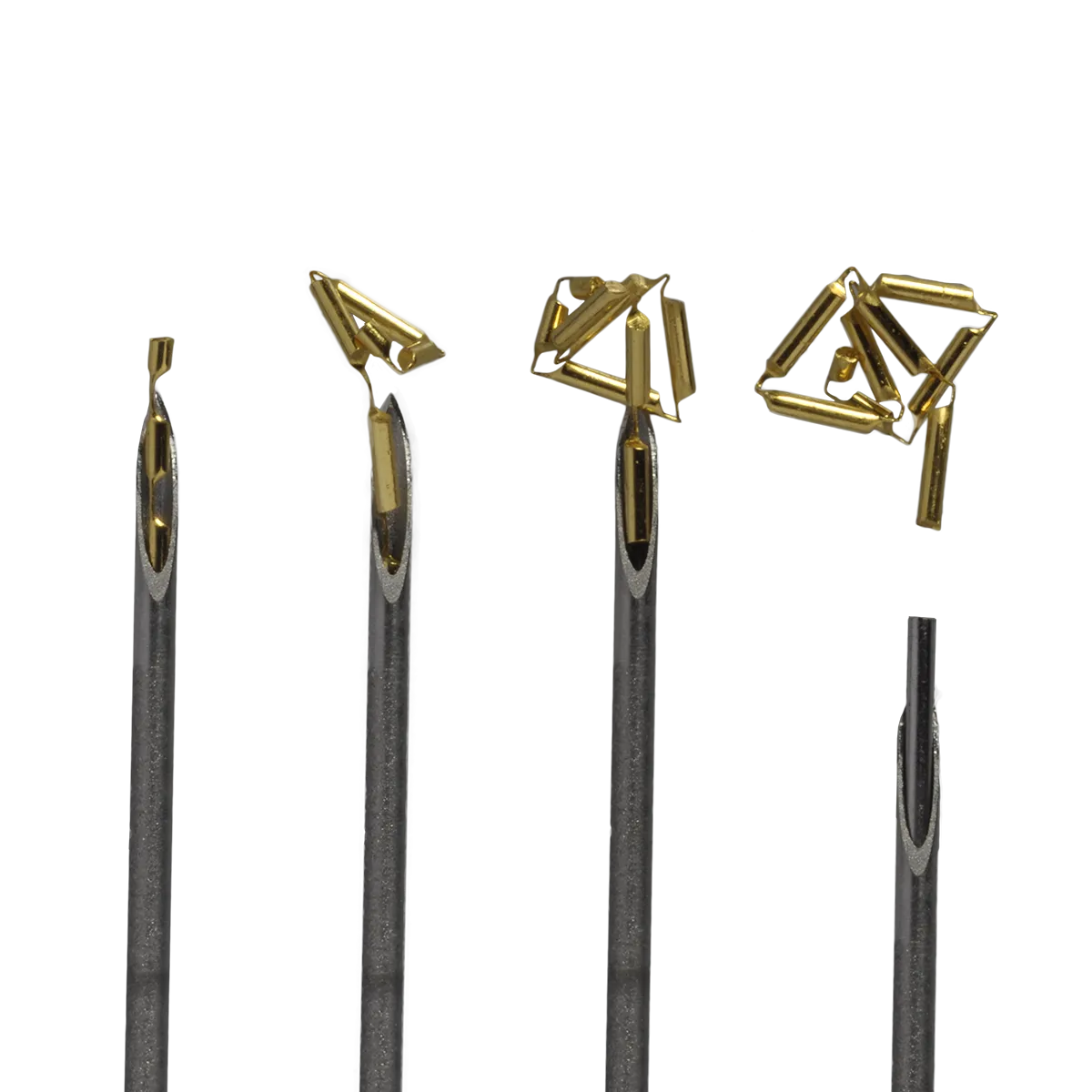
The Gold Anchor is a patented flexible gold-iron fiducial wire pre-loaded in an industry-leading thin needle. Multiple machined cut-outs cause the wire to fold on deployment — anchoring instantly in soft tissue for zero migration throughout the radiotherapy course. Visible on kV, MV, CBCT, CT and MRI, it enables precise image-guided and real-time tracking across the full spectrum of modern linac, particle and robotic radiotherapy platforms.
Key Features
- Patented gold-iron alloy wire with multiple machined cut-outs — folds on deployment for immediate soft-tissue anchoring
- Zero marker migration — stable position confirmed across the full radiotherapy course
- Industry-leading thin needle gauge — minimal invasiveness, no anesthesia typically needed
- Visible on kV, MV, CBCT, CT and MRI — multi-modality image guidance in a single marker
- MRI-compatible and MRI-safe — supports MR-only radiotherapy planning workflows
Features
Zero Migration
Patented cut-outs cause the marker to fold and mechanically lock in soft tissue the instant it exits the needle — confirmed stable across the full RT course.
Multi-Modality Visibility
Gold-iron alloy delivers strong contrast on kV, MV, CBCT, CT and MRI — the only flexible fiducial visible across every imaging modality used in modern radiotherapy.
Thin-Needle Deployment
Pre-loaded in an industry-leading thin needle (including 22G endoscopic) for EUS-guided pancreatic and bronchoscopic lung placements — minimal trauma, no anaesthesia typically required.
Real-Time Tracking
Compatible with SyncTraX, Varian Synchrony, CyberKnife and Elekta intrafraction management — enables continuous tumour tracking during beam delivery for liver, lung and prostate SBRT.
Particle Therapy Validated
Clinically validated in proton and carbon-ion IGRT programmes. The gold-iron alloy provides high contrast imaging with negligible beam perturbation at clinical particle therapy energies.
MRI-Only Workflow
Fully MRI-safe with no susceptibility artefact distortion at 1.5T and 3T. Enables MR-only treatment planning without CT co-registration — reducing workflow steps and imaging dose.
Technical Specifications
| Material | Gold-iron alloy wire (flexible, with machined cut-outs) |
| Design | Multiple cut-outs — folds and anchors on deployment |
| Imaging visibility | kV, MV, CBCT, CT, MRI (all modalities) |
| MRI status | MRI-compatible and MRI-safe |
| Delivery system | Pre-loaded in thin implantation needle (standard and endoscopic 22G) |
| Migration | Zero migration — patented anchor mechanism |
| Deployment locations | Prostate, liver, lung, pancreas, cervix, endometrium, esophagus, rectum, breast |
| Contraindications | Not for heart, large blood vessels, brain, spinal cord or eyes |
| Procedure time | 5–15 minutes (prostate); image guidance recommended |
| Permanence | Permanent (removable only by surgery) |
| Airport security | Not detected in routine security screening |
| Clinical evidence | 45+ peer-reviewed publications; prostate, liver, lung, pancreas, gynecologic |
| AERB / import status | Import licence required; Saxsons Group manages regulatory documentation |
Platform Compatibility
Varian
TrueBeam Auto Beam Hold · On-board kV imaging
Elekta
XVI Seed Match · Intrafraction Motion Management
Accuray
CyberKnife Synchrony · TomoTherapy & Radixact MVCT
Brainlab
ExacTrac Dynamic® fiducial tracking
Hitachi / IBA / Varian
Proton therapy with real-time gating
HIMAC / NIRS
Carbon-ion radiotherapy with fiducial localisation
SyncTraX
Real-time tumour-tracking IGRT for liver SBRT
All platforms
CT/MRI fusion · MR-only planning workflows
Gold Anchor has been validated on Varian, Elekta, Accuray and Brainlab linacs, as well as proton and carbon-ion systems. It supports both CT-guided and MR-only planning workflows through its dual kV and MRI visibility.
Clinical Applications
Eight organ sites — one fiducial solution
Prostate IGRT & SBRT
The most widely published application. Gold Anchor markers are implanted transperineally or transrectally for daily kV or CBCT-guided prostate radiotherapy. Thin needles and instant anchoring make the procedure fast and well-tolerated.
Liver IGRT & SBRT
Real-time tumour tracking in the liver using SyncTraX and Gold Anchor fiducials. The flexible anchor design maintains marker position despite respiratory motion — critical for liver SBRT dosimetric accuracy.
Lung IGRT & SBRT
Transbronchial, CT-guided or endoscopic placement for peripheral and central lung lesions. Gold Anchor's thin needle minimises pneumothorax risk. Compatible with respiratory gating and real-time tracking.
Pancreas IGRT
Endoscopic ultrasound-guided (EUS) placement via 22G needle directly into the pancreatic tumour. Gold Anchor is a preferred choice for EUS-guided fiducial marking because its flexibility accommodates the endoscope trajectory.
Gynecologic Radiotherapy
Fiducial marking of cervical, endometrial and other gynaecological tumours for IGRT. MRI visibility enables MR-guided adaptive radiotherapy workflows without the need for secondary CT co-registration.
Breast — Biopsy & RT
Post-biopsy clip marking to preserve lumpectomy site geometry. Also used as a radiation boost target marker in whole-breast IGRT, particularly for accelerated partial breast irradiation (APBI).
Surgical Guidance
Pre-surgical marking of lung nodules, pancreatic tumours and other lesions to guide video-assisted thoracoscopic surgery (VATS) and laparoscopic resection. The visible marker eliminates intraoperative localisation uncertainty.
Particle Therapy
Used in proton and carbon-ion facilities for daily image-guided alignment. The gold-iron alloy provides high contrast on both kV imaging and MRI, with negligible particle therapy beam perturbation at clinical energies.
Why Gold Anchor™ Fiducial Marker?
Conventional coil or cylindrical fiducials migrate because they rely on friction alone. Gold Anchor's patented cut-outs cause it to fold and mechanically lock in soft tissue the moment it exits the needle — confirmed stable in prostate, liver, lung and pancreatic SBRT series with follow-up imaging across the full treatment course.
Gold-iron alloy gives strong contrast on kV, MV, CBCT and CT while remaining MRI-compatible — rare for metallic implants. Departments running MR-only planning workflows can use the same fiducial without switching products. CT/MRI fusion-based planning is fully supported.
More peer-reviewed publications than any comparable flexible fiducial. Evidence spans prostate SBRT, liver tracking with SyncTraX, lung IGRT, EUS-guided pancreatic marking, gynecologic IGRT and particle therapy. Developed by the co-inventors of SBRT at Karolinska University Hospital — the clinical evidence base is built into the product's origin.
"The Gold Anchor has the thinnest needle and the best MRI visibility of any flexible fiducial I have used. It simply does not move once placed — which is exactly what you need for daily IGRT."
Radiation Oncologist, Tertiary Cancer Centre, India (Saxsons reference account)
Catalogs & Resources
Catalogs and brochures across the Gold Anchor range. White papers and clinical evidence live on the Knowledge Hub — link above.
Product selection guide
Decide which Gold Anchor variant suits your clinical indication — diameter, length, alloy and needle gauge.
Prostate brochure
Full clinical brochure for prostate IGRT and SBRT — placement, imaging, dosimetry.
Any organ brochure
Multi-site fiducial marking — liver, lung, pancreas, gynecologic and more.
Breast biopsy marker brochure
Post-biopsy clip and tumour-bed boost marker for whole-breast IGRT and APBI.
Videos
Implantation technique and customer testimonials from the clinical teams that use Gold Anchor every day. Educational and background videos are on the Knowledge Hub.
Gold Anchor™
More for this product
Each card opens a focused post for a specific specialty — peer-reviewed evidence and clinical workflow, written for the persona you select.
For Radiation Oncologist
Intrafraction motion in prostate SBRT
Conventional coil and cylindrical fiducials migrate up to 19–47 %. Can a 0.32 % migration rate change how prostate SBRT is planned?
Read thisRadiation OncologistRespiratory motion in liver SBRT
When the target moves with every breath, what does it take to get from 5.3 mm soft-tissue alignment error down to 1.5 mm?
Read thisRadiation OncologistCoil marker migration in lung SBRT
Roughly one in five standard coil markers migrate in lung parenchyma. What changes with a fold-anchor design and a thinner needle?
Read thisRadiation OncologistParticle-therapy beam compatibility
What is the proton-fluence perturbation at clinical energies — and how do Gold Anchor fiducials compare to gold cylinders and titanium markers?
Read thisRadiation OncologistClinical evidence — across organ sites
A single-page overview of where the published evidence sits for prostate, liver, lung and particle therapy.
Read thisFAQ
Fiducial markers, IGRT, SBRT — questions we hear from Indian radiation-oncology teams
Why implanted fiducials matter for prostate, liver, lung and pancreas SBRT; how the Gold Anchor fold-anchor design removes the migration and needle-size problems of traditional gold seeds; and how the marker is supplied and supported across India.
Q.Why do prostate, liver, lung and pancreas radiotherapy patients need fiducial markers at all?
Modern IGRT and SBRT plans deliver tightly-conformed high-dose radiation with sub-millimetre margins. Soft-tissue targets (prostate, liver, lung, pancreas) drift day-to-day and breath-to-breath — bone alignment on cone-beam CT is not enough. Implanted radio-opaque fiducial markers give the linac a stable image target so the couch can be corrected against actual tumour position before every fraction; without them, the margin has to be expanded and healthy tissue takes the hit.
Q.What problem do Gold Anchor markers solve that traditional gold-seed and coil markers don't?
Traditional cylindrical gold seeds require 17–19 G needles that carry meaningful bleeding and migration risk in soft parenchyma (liver, lung, pancreas). Gold Anchor is a thin gold-iron wire with machined cut-outs that folds into a compact shape on deployment, so it can be delivered through a 22 G / 25 G pencil-point needle. Migration and inter-fractional displacement rates published in the peer-reviewed literature are markedly lower than for cylindrical seeds (0.32 % migration over 5 years in the reference prostate cohort), and the smaller needle bore reduces pneumothorax risk in lung deployment.
Q.Can Gold Anchor be used for MR-only radiotherapy planning?
Yes. The gold-iron alloy produces a distinctive susceptibility signature on T2* MR sequences — visible as a small dark void with a characteristic bloom, unlike pure gold which is invisible on MRI. This is what enables MR-only prostate planning workflows where CT can be dropped from the pathway. Published detection rates approach 95 % on standard MR sequences.
Q.Which linacs and imaging modalities can see Gold Anchor markers?
Gold Anchor is visible on every linac imaging modality in clinical use: kV planar orthogonal imaging, MV portal imaging, CBCT (cone-beam CT on Varian, Elekta, Accuray platforms), CT simulation and T2* MRI. The marker also lights up on ultrasound and fluoroscopy so it can be verified intra-procedurally by the interventional radiologist during placement.
Q.How is Gold Anchor supplied and supported in India?
Gold Anchor is distributed across India by Saxsons Group under SKU RT-006. Delivery is direct to the interventional radiology suite or radiotherapy department in sterile single-use pre-loaded applicators. Saxsons handles the CDSCO medical-device import registration and provides applications training for interventional radiologists new to the fold-anchor deployment technique.
Gold Anchor Fiducial Marker supplier in India — Saxsons Group
Saxsons Group has supplied radiotherapy equipment to over 1,000 Indian hospitals since 1988. Every consignment of Gold Anchor Fiducial Marker ships with cold-chain logistics, AERB import documentation, CDSCO registration references and a Certificate of Analysis delivered before dispatch — the paperwork your radiation-safety and procurement teams need, pre-assembled.
- Nationwide delivery footprint — every metro and tier-2 city in India, scheduled to your treatment / procedure calendar.
- AERB & CDSCO documentation — import licence, radiation-safety paperwork and RSO briefing pre-assembled for the audit file.
- 40+ years in Indian oncology — long-standing supply relationships with AIIMS, Tata Memorial, and hundreds of tertiary-care centres.
- Single point of accountability — one purchase order, one delivery contact, one after-sales team across the whole product family.
Also supplied by Saxsons Group across India
Bring Gold Anchor to your radiotherapy department
Saxsons Group supplies Gold Anchor fiducial markers across India with full import documentation, clinical in-service training and ongoing application support. Contact us to start a trial order or arrange a demonstration implantation workshop.