
Authorised Indian Distributor
Saxsons Group
New Delhi, India · Since 1997
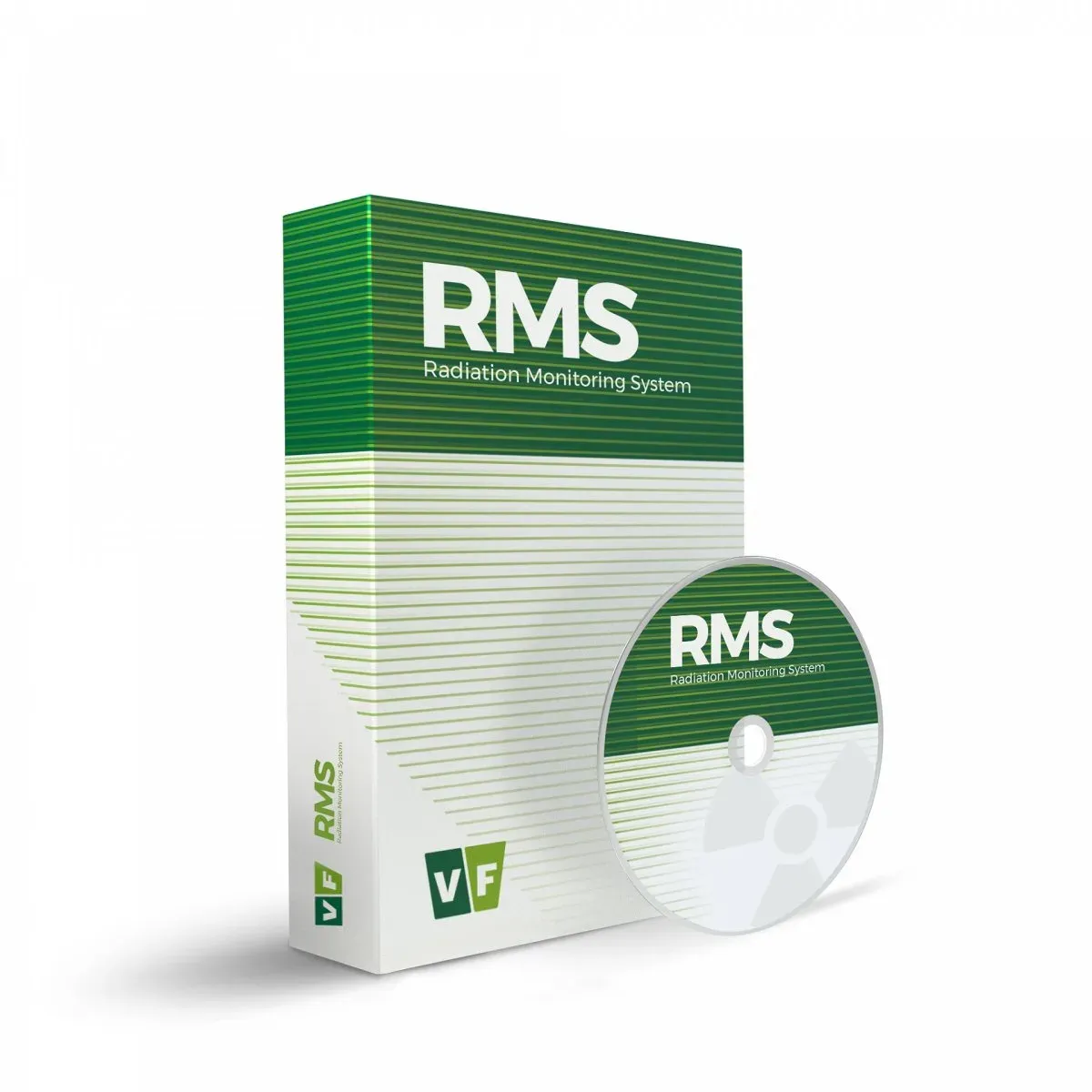
RMS ServerCentral Radiation Monitoring System — Server + Software
The central hub of the site radiation-monitoring system. Aggregates dose-rate, contamination, stack and air-monitor data from a large fleet of area monitors into one console — single-channel and multi-channel tables and graphs, alarm management, archived value history. Modular architecture scales from a small PET centre to a multi-vault cyclotron-and-therapy facility.
Key Features
- Central server and software application that provides complete management of the site radiation monitoring system
- Connects to area gamma monitors (AGM-03), neutron monitors (MDN-01), hand-foot contamination monitors (HF-4), stack monitors (PET-01) and other field detectors
- Detectors connect either directly to the server via LAN / RS-485, or indirectly via RPU / RDU display units that aggregate a small cluster
- Single-channel and multi-channel tables and graphs — the radiation safety officer compares dose-rate trends across vault, hot-lab and stack monitors on one screen
- Actual and archive value management — current readings alongside historical trending for inspection-ready dose-rate logs
All Features
- Central server and software application that provides complete management of the site radiation monitoring system
- Connects to area gamma monitors (AGM-03), neutron monitors (MDN-01), hand-foot contamination monitors (HF-4), stack monitors (PET-01) and other field detectors
- Detectors connect either directly to the server via LAN / RS-485, or indirectly via RPU / RDU display units that aggregate a small cluster
- Single-channel and multi-channel tables and graphs — the radiation safety officer compares dose-rate trends across vault, hot-lab and stack monitors on one screen
- Actual and archive value management — current readings alongside historical trending for inspection-ready dose-rate logs
- Modular software architecture — start with one cluster of monitors, add channels as the facility grows without re-architecting the server
- Alarm management — threshold configuration, escalation logic, alarm-acknowledgement audit trail
- Suitable for nuclear facilities, waste management, ionizing-radiation metrology, environmental monitoring, nuclear medicine and non-nuclear industry deployments
- Compatible with environmental, air and liquid monitors alongside the field area / contamination monitor fleet
- AERB-compliant deployment — the central log is the inspection-ready dose-rate record
- Saxsons site survey + India commissioning support
- Documentation: system architecture diagram, commissioning records, AERB compliance paperwork
Technical Specifications
| Product role | Central server + software hub for the site radiation monitoring system (RMS) |
| Architecture | Modular — scales from a single PET-centre cluster to a multi-vault cyclotron-and-therapy facility |
| Compatible detectors | Area gamma (AGM-03), neutron (MDN-01), contamination (HF-4), stack / air (PET-01), plus environmental, air and liquid monitors |
| Connection topology | Direct LAN / RS-485 from detector to server, or LAN / RS-485 from RDU display unit to server (RDU aggregates a small cluster) |
| Display | Single-channel and multi-channel tables and graphs; user-friendly graphical interface |
| Data management | Actual + archive values; long-term trending; alarm-event log |
| Alarm management | Per-channel thresholds, escalation logic, alarm-acknowledgement workflow |
| Application areas | Nuclear facilities, waste management, ionizing-radiation metrology, environmental monitoring, nuclear medicine, non-nuclear industry |
| Deployment | On-site server + central console workstation; Saxsons commissioning + India site support |
| AERB framework | Central log serves as the AERB-inspection-ready dose-rate dossier |
Applications
The central console behind every AERB-licensed radiation programme
Cyclotron + PET centre
One RMS server aggregates the vault-side neutron field, the hot-lab area gamma monitors, the stack / exhaust monitor, the egress contamination frisker and the personnel-dose record. Inspection-time, the centre presents one coherent dose-rate dossier instead of four separate paper trails.
Theranostic centre
Lu-177 / I-131 / Ra-223 wards generate localised dose-rate fields around patient rooms and waste-store. The RMS server tracks each location independently and alarms when a region rises out of band — typically a contamination event needing rapid response.
Cyclotron commissioning
During commissioning, the RMS server records the baseline dose-rate map across the facility. The baseline becomes the comparison point for routine operational monitoring and inspector queries.
Multi-site programme
A hospital network with multiple PET centres or theranostic centres can run one RMS architecture across sites — site-local servers federate to a central administration console for the radiation-safety officer who covers the network.
AERB inspection prep
A clean RMS export — area gamma, neutron, contamination and stack trends across the inspection window — is a far stronger inspection narrative than a stack of paper printouts. The export is the audit trail.
Incident reconstruction
When a dose-rate spike triggers an internal investigation, the RMS archive lets the radiation-safety officer reconstruct the timeline across every channel. The investigation runs from data, not from memory.
Why RMS Server?
Without a central RMS, each area monitor produces its own local trace; correlating a vault-side neutron rise with a stack-monitor reading means walking two corridors and reading two charts. The RMS server puts every channel on one screen — the radiation safety officer correlates events instead of reconstructing them.
A first-year PET centre might deploy three area monitors and a contamination frisker — the RMS server runs that cluster fine. Year three the centre adds Lu-177 theranostics and three more area monitors; the same RMS scales without re-architecture. The capex on the server stays useful as the facility grows.
AERB inspection looks for documented dose-rate history, not just current readings. The RMS archive — every channel, every event, every alarm acknowledgement, time-stamped — is the inspection record. The hospital does not have to assemble the dose-rate dossier reactively; the RMS has been collecting it continuously.
Catalogs & Resources
Manufacturer product page. Contact Saxsons for site survey, architecture design, AERB compliance paperwork and India commissioning.
RMS Server
More for this product
Each card opens a focused post for a specific specialty — peer-reviewed evidence and clinical workflow, written for the persona you select.
FAQ
RMS server (central radiation monitoring) — questions we hear from Indian cyclotron RSOs
Why single-detector logs don't scale, what the audit-trail archive delivers at AERB inspection, what alarm-management the server provides, and which Saxsons detectors integrate into one facility-wide dashboard.
Q.What does an RMS (Radiation Monitoring System) server actually do at a cyclotron facility?
A cyclotron facility runs many independent radiation detectors — area gamma monitors at multiple locations, neutron monitors, stack effluent monitors, hand-foot contamination monitors, individual RDU-02 displays. Without a central server, each device produces its own log; reconstructing a facility-wide dose picture at AERB inspection or during an incident investigation means walking device to device pulling paper printouts. The RMS server pulls every channel from every device into one central database — one query returns the facility-wide dose history for any time window.
Q.What audit-trail requirement does the RMS server fulfil?
AERB inspection looks for continuous, documented dose-rate history across the licensed facility — not just current readings. The RMS archive stores every channel, every event, every alarm acknowledgement, timestamped and tamper-evident. The department does not compile the dose-rate dossier reactively when the inspector arrives — the RMS has been collecting it continuously. That single-source-of-truth is what makes AERB inspection preparation an export operation rather than a manual reconstruction.
Q.What alarm-management capability does the RMS provide?
Configurable per-channel alarm thresholds. Facility-wide alarm map showing which channels are in alarm, when they entered alarm state, and who acknowledged them. Escalation routing to email / SMS for defined-severity alarms. Historical alarm-event query so a post-incident investigation reads the full alarm sequence and acknowledgement chain from one dashboard.
Q.Which detectors integrate with the RMS server?
AGM-03 area gamma monitors, PET-01 stack effluent monitors, neutron dose-rate monitors, HFCM hand-foot contamination monitors, RDU-02 corridor displays — all detectors in the Saxsons cyclotron-facility monitoring family feed into one RMS server. Third-party detectors integrate via standard protocols (Modbus TCP, OPC-UA) depending on the vendor.
Q.How is the RMS server supplied and installed in India?
Distributed across India by Saxsons Group. Supply covers the server hardware, software licence, facility-wide architecture design (which detectors feed the server, where the RDU-02 displays sit), commissioning against AERB Regulatory Requirements for Medical Cyclotron Facility and India commissioning support.
RMS Server supplier in India — Saxsons Group
Saxsons Group has supplied cyclotron equipment to over 1,000 Indian hospitals since 1988. Every consignment of RMS Server ships with cold-chain logistics, AERB import documentation, CDSCO registration references and a Certificate of Analysis delivered before dispatch — the paperwork your radiation-safety and procurement teams need, pre-assembled.
- Nationwide delivery footprint — every metro and tier-2 city in India, scheduled to your treatment / procedure calendar.
- AERB & CDSCO documentation — import licence, radiation-safety paperwork and RSO briefing pre-assembled for the audit file.
- 40+ years in Indian oncology — long-standing supply relationships with AIIMS, Tata Memorial, and hundreds of tertiary-care centres.
- Single point of accountability — one purchase order, one delivery contact, one after-sales team across the whole product family.
Also supplied by Saxsons Group across India
Aggregate every radiation channel into one console
Contact Saxsons Group for RMS server architecture, site survey, AERB compliance paperwork and India commissioning of the central radiation monitoring system.