
Knowledge Hub · Saxsons Dose Cabinet
A nuclear-medicine hot lab needs four things.The Saxsons cabinet integrates all four.
Every NM hot lab — whether PET-only, SPECT-only, or running both plus I-131 therapy — has to do the same four things: measure the activity (dose calibrator), shield the operator during dose draw-up (L bench), contain the spent sharps during decay storage (sharps shield), and shield the ready dose for transport (vial shield — tungsten for PET, lead for SPECT and I-131). The Saxsons Dose Cabinet is a Saxsons own-brand workstation that packages all four into one self-shielded unit, made in India for Indian NM departments.
The four primitives
Every NM hot lab needs all four — the Dose Cabinet has all four built in
Primitive 1
Dose calibrator
Measures the activity in each vial / syringe before injection
Primitive 2
L bench
Shields the operator while the dose is drawn from the source vial
Primitive 3
Sharps shield
Contains spent syringes / vials inside the cabinet during decay storage
Primitive 4
Dispenser shield
Tungsten (PET) or lead (SPECT / I-131) vial shield for the ready dose
Why this matters
Six things the Dose Cabinet delivers, explained simply
Hotlab equipment, integrated
Four primitives, one cabinet, one capital line
A nuclear-medicine hot lab needs a dose calibrator, a shielded dispensing bench, a sharps decay container and a shielded dose dispenser. Most NM departments specify and buy these as four separate workstations. The Saxsons Dose Cabinet packages them into a single self-shielded unit — one capital decision, one validated workspace, one footprint.
Based on: Saxsons Dose Cabinet brochure — All-in-One Solution pillar; component list verbatim.
Open ↗PET shielding done right
Tungsten for 511 keV, not lead
PET tracers (F-18 FDG, Ga-68 PSMA / DOTATATE) emit 511 keV annihilation photons — twice the energy of Tc-99m's 140 keV. Lead at conventional dispenser thicknesses no longer gives adequate attenuation; tungsten, with a higher density (19.3 g/cc vs 11.3 g/cc for lead), is the appropriate material for the PET vial shield. The Saxsons cabinet ships with tungsten as default for PET configurations and with lead variants available for SPECT / I-131.
Based on: ICRP Publication 106 — Radiation dose to patients from radiopharmaceuticals (2008); standard radiation-shielding tables.
Read source ↗Time, distance, shielding
The L bench geometry serves the "distance" leg of ALARA
ALARA — As Low As Reasonably Achievable — is built on three operator-dose controls: time, distance and shielding. The L-shaped dispensing bench layout shortens the path between the dose calibrator, the source vial and the dispenser, which reduces operator time-at-source. The integrated workstation removes the inter-station walking the conventional four-piece hot lab forces on the radiopharmacist.
Based on: IAEA Safety Reports Series No. 40 — Applying Radiation Safety Standards in Nuclear Medicine; ICRP 105 — Radiological Protection in Medicine.
Read source ↗Decay storage at the point of use
The sharps shield is where spent syringes wait out the half-life
Used radioactive syringes and vials are not waste yet — they are short-half-life material that needs decay storage before they can be released to the general medical-waste stream. The integrated sharps container shield is where the spent dispensing material goes immediately after the dose is administered — kept inside the cabinet, behind the shielding, until the activity has decayed to background. AERB requires documented decay-then-release; the integrated shield gives the radiopharmacy a defined holding point.
Based on: AERB Safety Code for Nuclear Medicine Facility (India) — decay-storage and release requirements; AERB Atomic Energy (Radiation Protection) Rules 2004.
Read source ↗AERB-friendly engineered control
A documented engineered control for the AERB licensing dossier
When an Indian hospital applies to AERB for a nuclear-medicine facility licence, the dossier has to cite the engineered controls used in the hot lab. A documented self-shielded dispensing cabinet is one of the cleaner items to cite — it is a single named piece of equipment with a single specification, rather than four separately specified workstations that the radiation-safety officer has to argue add up to a compliant hot lab.
Based on: AERB Safety Code for Nuclear Medicine Facility; AERB licence application guidance for nuclear-medicine facilities.
Read source ↗India-made, India-supported
Designed and manufactured in India by Saxsons Healthcare
The Dose Cabinet is a Saxsons own-brand product — designed and built in India by Saxsons Healthcare Pvt. Ltd. for Indian nuclear-medicine hot labs. Spares, replacement tungsten / lead vial shields, dispenser-tray replacements, and on-site service all sit inside the Saxsons India service network — no import lead time for parts, no overseas teleassistance dependency for routine maintenance.
Based on: Saxsons Healthcare Pvt. Ltd. — manufacturer of the Dose Cabinet.
Open ↗Dose Cabinet at a glance
4-in-1
Hot lab primitives
Calibrator · L bench · Sharps · Dispenser
Tungsten
PET vial shield
Lead option for SPECT / I-131
SS top
Spill-proof lip
0.5″ stainless steel
Made in India
Saxsons own brand
India service network
In the field
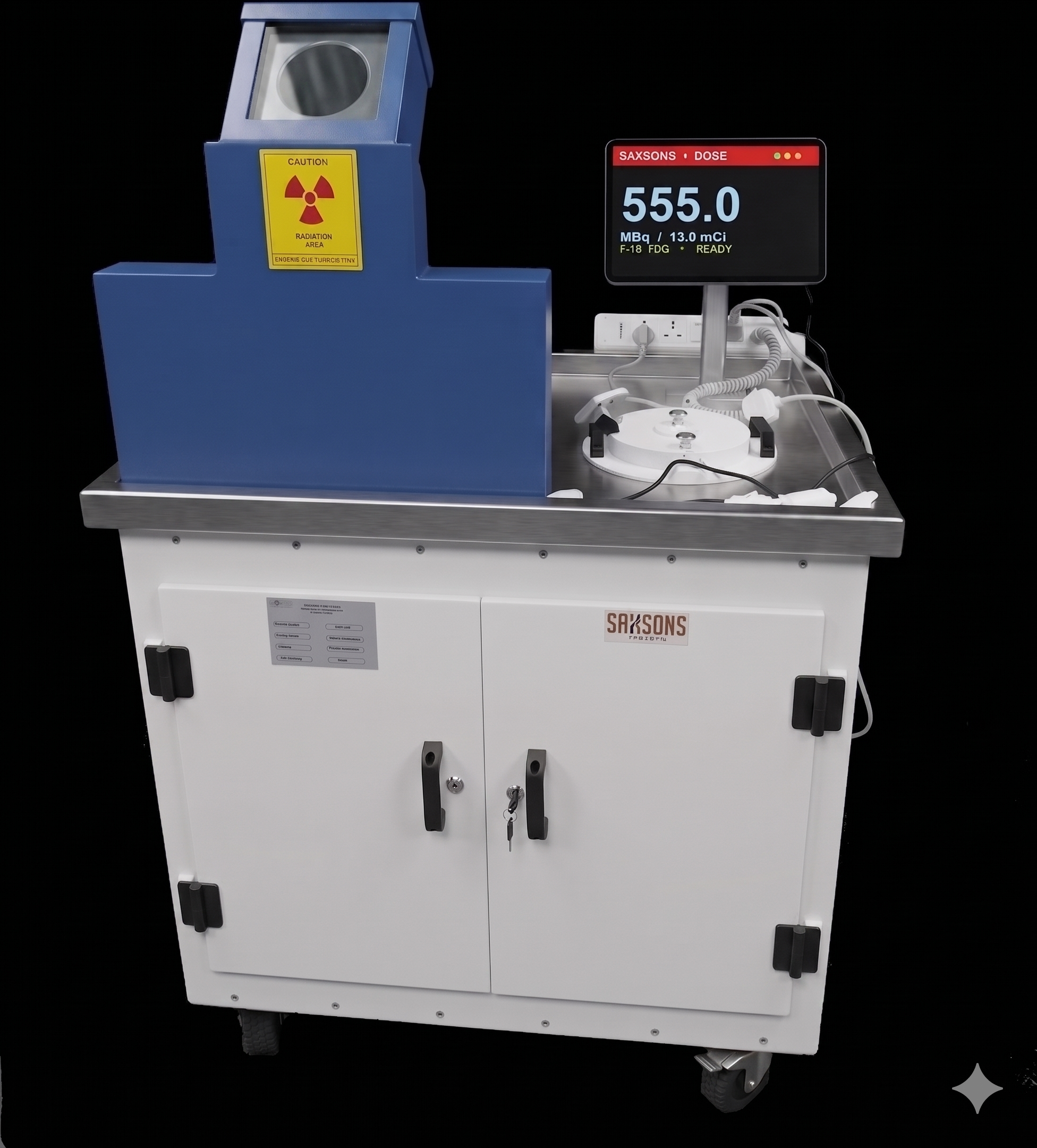
A Saxsons Dose Cabinet installed at an Indian NM department
The cabinet as deployed — Saxsons-branded white cabinet body on castors, the recessed dose calibrator station with its read-out screen, and the tungsten-shielded PET dispenser mounted on the left (the bright-blue housing carries the radiation-area caution placard). The integrated layout puts the operator's full draw-up workflow inside one arm-reach loop.
Scope of this page
The Saxsons Dose Cabinet is a workstation, not a complete radiation-safety programme. The hot lab still needs an AERB-licensed Radiation Safety Officer, a documented dispensing SOP, a validated decay-store-and-release log, operator training records and the broader hot-lab room shielding the AERB Safety Code expects. The cabinet provides the engineered controls at the dispensing point; the programme that wraps around it sits with the nuclear-medicine department. The brochure specifies the cabinet construction; isotope-specific configuration (tungsten vs lead vial shield, calibrator chamber selection) is decided at order time.
Saxsons brochure + Indian / IAEA regulatory references
The product brochure plus the AERB Safety Code and IAEA Safety Report that frame an NM hot lab in India.
Saxsons Dose Cabinet — product brochure (PDF)
Single-page brochure with the four-pillar positioning and component list.
AERB — Safety Code for Nuclear Medicine Facility
The Indian regulator's safety code that frames the licensing path for an NM hot lab.
IAEA Safety Reports Series No. 40 — Applying Radiation Safety Standards in Nuclear Medicine
IAEA reference for radiation-safety practice across an NM department.